

Widespread, structural, deeply felt
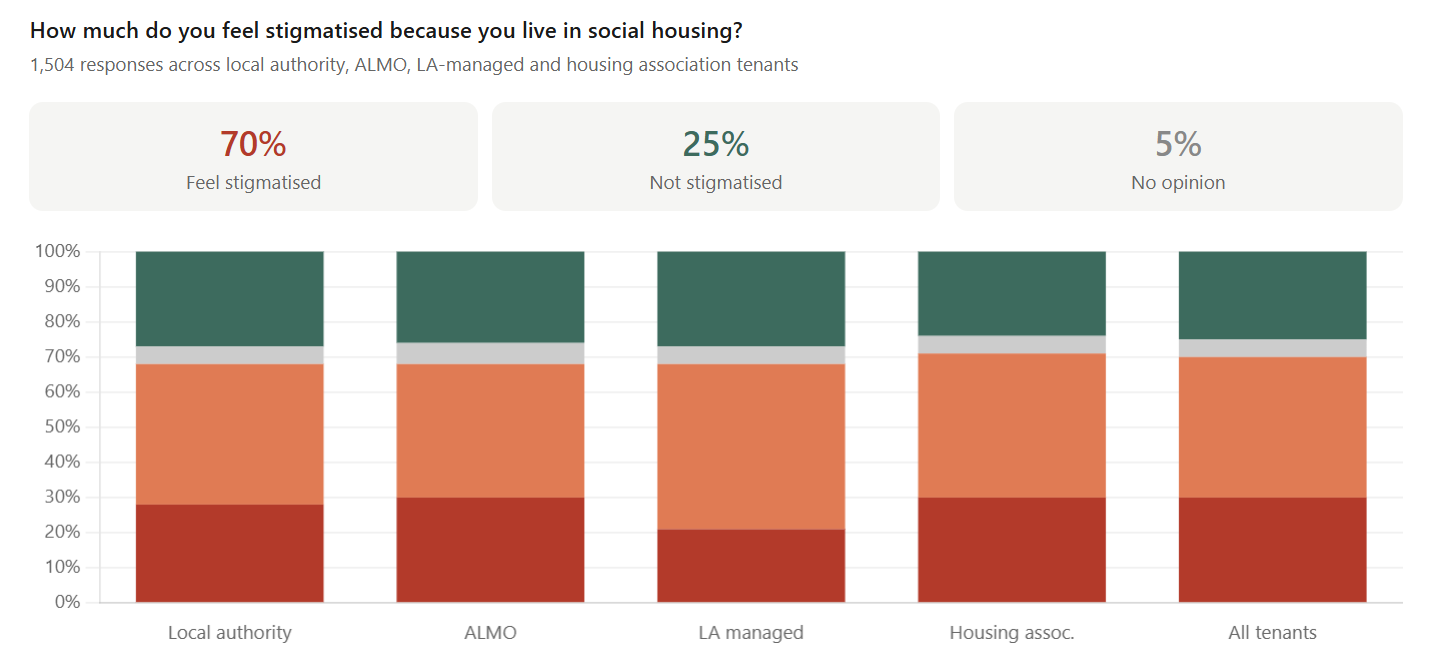
We asked social housing tenants across the country how much stigma affects them. 1,643 of you shared your views and experiences — good and bad.
Many thanks to every tenant who did!
- Over two thirds (70%) of social housing tenants feel stigmatised living in social housing
- Over half (54%) feel stigmatised because of the actions of their landlords
- Over two-thirds (68%) consider the Government has done little or nothing to address stigma
You can download our full report on the survey – Widespread, structural and deeply felt – below. You can also download – What Tenants Told us – a quick summary of the report.
Baroness Taylor OBE - Parliamentary Under-Secretary of State at the Ministry of Housing, Communities and Local Government said:
Thank you for your letter of 2 March and for sharing the latest findings from the Stop Social Housing Stigma National Tenant Survey.
As I said when we last met, I am very interested in this work and value the contributions of Stop Social Housing Stigma and the G15 Resident Group. My officials have updated me on your constructive discussions, including ideas to:
- improve the language used about social housing
- develop a public-facing campaign celebrating social housing
- involve residents earlier in policy development, including exploring a national tenant voice organisation.
I was pleased that you and G15 Residents Group colleagues contributed to the Department’s new Resident Stakeholder Forum in December, and I hope you found this engagement helpful. Officials have proposed a roundtable this spring with landlord and tenant representatives to consider what more we can do together to tackle stigma. I have agreed to chair this discussion. Ahead of the event, officials will speak with the National Housing Federation, the Local Government Association and the Chartered Institute of Housing to explore current activity and ask them to identify examples of good practice to bring to the roundtable.
As you noted in your letter, the findings from your recent research are concerning. This and further evidence such as from the Resident Panel’s online community and projects supported through the Social Housing Innovation Fund, including the G15 multi-landlord engagement work
will inform the roundtable agenda. As you know, the Government is already delivering a wide-reaching programme to increase social housing supply, improve the quality of homes and services, and strengthen residents’ voices. Our Pride in Place strategy will further empower local communities and residents. These measures will help address negative perceptions of social housing, and we will monitor their impact closely. The roundtable will be an important opportunity to consider what else may be needed and where responsibilities best sit across the sector.
I understand you are also meeting officials from the Department and the Regulator of Social Housing to discuss the regulator’s role, and I look forward to hearing the outcome of this discussion. I look forward to the roundtable and hearing about the subsequent progress on developing an action plan.
Thank you for taking the time to provide an update and I welcome your continued engagement with this Department on this important issue.
Kate Dodsworth from the Regulator of Social Housing said:
Thank you for sharing the survey analysis and please pass on our appreciation to the organising committee for their work in highlighting tenant experiences across the country.
We’ve reviewed the report with interest. The findings align with previous work in the sector and confirm that tenants see safe, quality homes and strong consumer standards as essential to addressing social housing stigma. We remain committed to effective regulation that tackles poor performance, and revisions to our standards — including new elements on competence and conduct — will reinforce the importance of treating all tenants with fairness and respect, while expanding landlord responsibilities in this area.
Our view is that the most effective way we can contribute to addressing the complex, multi-faceted problem of social housing stigma is by ensuring landlords deliver against the consumer standards.
Richard Blakeway the Housing Ombudsman said:
“The results from this report should be a moment the sector stands still and reflects. Stigma in social housing must be tackled wherever it is found. It is clear that too many actions being taken, even if they are being made with the best of intentions, are not having a positive impact on how residents feel about the homes they live in.
“The need to hear residents’ voices on these issues and tackle stigma is one of the reasons we called for a national resident representative body in our latest Spotlight report.
“Stigma is sometimes overt in our casework but more often unconscious, such as poor communication or missed appointments. We have called out both in our reports, but there is more everyone in the sector can do.”
We have also asked:
- the Conservative Party
- the Green Party
- the Liberal Democrat Party
- Reform UK
their views on what tenants told us. We shall publish their responses when we receive them.
Tenants and tenants’ organisations
- sign up as members of the Campaign (it’s free)
- ask your landlord to sign up as members of the Campaign (it’s also free)
- discuss the tenant survey report at your next tenant meeting
- ask your landlord what they are doing to tackle stigma and how you can work with them on it
- invite Stop Social Housing Stigma to talk to your tenant group and to your landlord
- tell your Chief Executive and Board members (if you are a housing association tenant) or your Director of Housing and your Councillors (if you are a Council tenant) about our call for action
- discuss our Tackling Stigma Journey Planner with your landlord
- get involved with discussions with your landlord about what language should be used and behaviours and attitudes that are acceptable
- don’t take no for an answer. Stigma is a fundamental issue for most tenants
All senior sector leaders
- sign up as members of the Campaign
- understand the importance of tackling stigma for the tenants you are there to serve
- make it a priority issue in your organisation
- participate in an initial joint seminar with us to discuss the way forward on tackling stigma, culture, attitudes and behaviours
- and then participate in ongoing stigma debates
Government & MHCLG
- develop a tackling stigma vision and publicise a national strategy to send a clear message that it wishes to tackle social housing stigma
- initiate a Royal Commission to review how housing is delivered in the UK that aims to present all forms of housing as of equal benefit
- consider whether and how social housing stigma and discrimination against social housing tenants could be made unlawful and included in Equality Act provisions
- consider whether Government could cease referring publicly to the term “social housing” in order to signal that it wishes to stop social housing stigma and to encourage the concept that all housing is of equal merit
- enable discussion with the Charity Commission and SSHS regarding how the Commission can ensure that the charities it regulates actively seek to tackle stigma that their beneficiaries are subject to
MPs and Councillors
- sign up as SSHS members to support the campaign to tackle stigma
- ask questions about how national and local Government is tackling social housing stigma
The Regulator
- require that landlords have a tackling stigma strategy
- use the Consumer Standards Code of Practice and other means to initiate debate in the social housing sector about tackling stigma and what concepts such as fairness, respect, courtesy, acceptable behaviours mean
Trade and sector representative bodies
- formally state that it is unacceptable that so many tenants feel that they are the underclass
- sign up to the Campaign
- develop ongoing engagement with the Campaign to enable sector leadership of tackling stigma initiatives
Landlords and your staff
- become members of the Campaign
- engage with and contribute to the Campaign’s activities
- have ongoing dialogue with tenants about how best to tackle stigma
- use the Tackling Stigma Journey Planner and other methods to engage with tenants on this debate
- change your culture, behaviours and attitudes
- consider language you use – does it promote a culture of home?
- don’t let anything happen in a tenant’s home that you would not want to happen in your home
Decision makers in landlords (boards and councillors)
- understand what feeling like and being considered the underclass means for tenants
- take responsibility for tackling stigma
- ask officers for regular updates on your tackling stigma strategy
Contractors
- sign up to the campaign
- work with us to ensure that your operatives and your sub-contractors understand stigma and do not contribute to it
- ask client landlords what they are doing to tackle stigma and participate in their debates with tenants about stigma
Operatives
- think carefully about what social housing stigma is and how it works
- don’t do anything in a tenant’s home that you wouldn’t want to see happening in your or a member of your family’s home
Solicitors, accountants, surveyors, internal auditors, advisors to the social housing sector
- sign up to the campaign
- think carefully about your role in the social housing sector and how you can help to tackle social housing stigma
- ask questions about stigma of your Registered Provider landlord clients
The press and the media
- review our press guide
- work with us on renewing it and let us help you understand the impact of biased views towards social housing tenants
The housing press
- regularly challenge Government, landlords and everyone else about what is being done to tackle social housing stigma
Everyone and everyone else
- be rightly shocked by the statistics we have gathered in our national tenant survey
- do something about it
- sign up to the campaign